

Constructivism and Materialism: What's the Role of Ideas in the Social Sciences?

In an effort to practice writing more, I’m going to try and write short pieces on the things I’m reading for my PhD comps. I want to keep them around 750 words, both to challenge and limit my writing. The pieces will be really about anything (of course within the subject of IR) that I thought of when reading the books/papers. Enjoy!
For my PhD exams I’ve been reading chapters from Alexander Wendt’s Social Theory of International Politics (1999). For those who are not international relations (IR) scholars, Wendt is most famous for helping establish the “constructivist” theoretical school. In contrast to neorealism and neoliberalism, constructivism emphasizes how ideas shape and are shaped by the social understandings of human relations (Adler 1997, 322). Constructivism is more so a methodological approach rather than a theory, and in IR it’s typically the framework that authors use to explain outcomes in international politics.
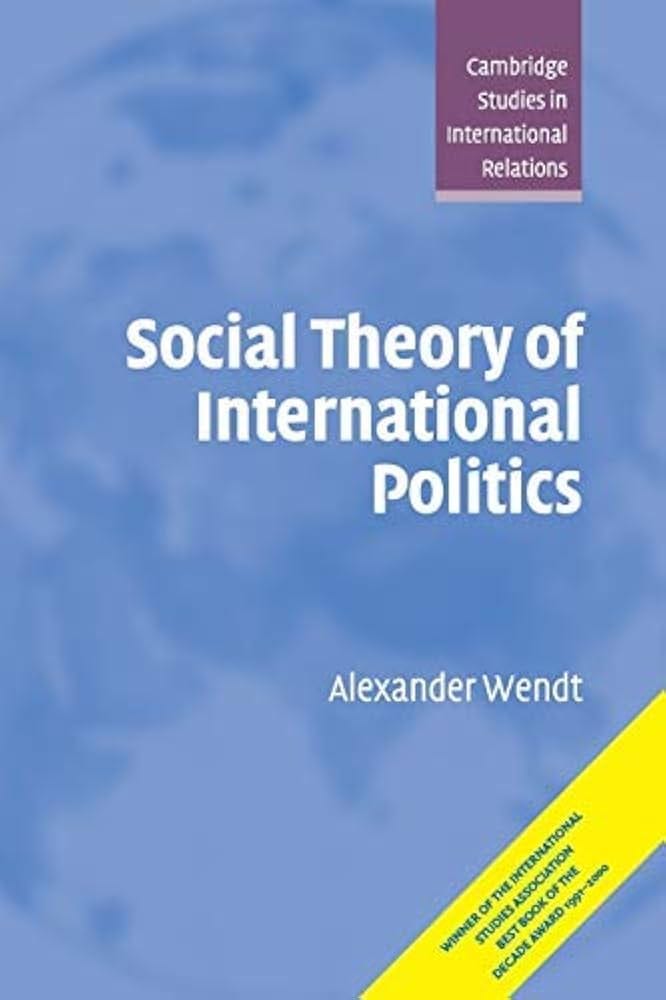
While I disagree with the overall argument and project that Wendt is forwarding in the book, I think the intellectual exercise he engages in is very helpful. Wendt in particular argues that the structure of international politics is primarily determined by “social” rather than “material” forces (1999, 20). That is, the international system itself shapes the identities of the actors (mainly states) and therefore, their behaviour.
Wendt makes some useful clarifying statements on how to divide the features of different social theories, such as the divisions between holism/individualism and idealism and materialism. The latter dichotomy is relevant to a particular “problematic” that Marxists deal with far too often: the relationship between the base (often seen as material) and the superstructure (often seen as ideational). Without going too deeply into his argument, there are a few issues with his proposed solution to this problem.
Wendt proposes a “third way” between materialism and idealism which is meant to capture that while there is an ontological priority to “real” (i.e., material/physical) structures, ideational elements are central to understanding the social world. The issue is that despite arguing against this “crude materialism”, Wendt ultimately seems to accept that the emphasis on “material” capacities is largely reducible to this.
Wendt is aware that it’s problematic to pose such a stark division between these two “realms”, yet he still explicitly proposes what he calls a Cartesian model of divided the “material” and “ideas”, which in practice is more so a separation of nature and society. Ultimately, while his ontology can function perfectly fine at times, it fails to provide a proper grounding for a correct “materialist” theory.
Materialism (taken from Marx and Engels) does not capture merely that actors exist in the 'physical’ world, but it combines that very fact with the social nature of humans. The historical materialist belief starts with the unity of the physical and social production of human lives, even in its most general form. In fact, I think Wendt’s theory accounts for this, but the framing of there being a separate ontology between “relations” and “forces” of production takes the separation of nature and humans too far. Ironically, I think he’s doing what Marxists in the early 20th century were doing, which is to view the determination of technology as more neutral and more abstractable to other societies than it is in practice.
What Wendt seems to be more accurately trying to capture is the difference between abstract-determinations and determinate-determinations, to use Patrick Murray’s phrasing (1990). Specifically, rather than separating the material-social, I think using a language that tries to capture properties of social relations that are transhistorical vs. historically specific better captures the relationship between nature-society-people. With this, you can capture both the constitutive relationships between “material” and “ideational” variables.
Historical materialism is meant precisely to capture that all human societies produce themselves (spatially/temporally) through the appropriation of nature as part of a specific form of society (497). Here, the ‘physical’ and ‘ideal’ are always inherently unified in a holistic methodological framework, rather than having to parse them out. Instead, the use of abstract-concrete analysis allows for the reconstruction of relations between entities in order to understand how they function, i.e., understand society itself.
References
Adler, Emanuel. “Seizing the Middle Ground: Constructivism in World Politics.” European Journal of International Relations 3, no. 3 (1997): 319–63. https://doi.org/10.1177/1354066197003003003
Bhaskar, Roy. 1978. “On the Possibility of Social Scientific Knowledge and the Limits of Naturalism.” Journal for the Theory of Social Behaviour 8 (1): 1–28. https://doi.org/10.1111/j.1468-5914.1978.tb00389.x.
Geert A. Reuten, The Unity of the Capitalist Economy and State: A Systematic-Dialectical Exposition of the Capitalist System, Historical Materialism Book Series, volume 186 (Leiden: Brill, 2019), 607.
Murray, Patrick. Marx’s Theory of Scientific Knowledge. Repr. in paperback. Humanitities Pr. International, 1990.
critic of political economy is supported by your own subscriptions and donates. If you aren’t already one, you can become a paid subscriber on Substack or make a one time donation of a ★🚩revolution🚩★ here . If you’re Canadian, you can email me at criticofpoliticaleconomy@proton.me to set up an account and pay with etransfer, as this avoids fees and taxes for me and the exchange rate for you.