

How Does the Capitalist State Support the Economy? (Infrastructure Series Part 2)
A series on the political economy of infrastructure financing

This post is part of my series on the political economy of infrastructure financing. It discusses the politics and economics of providing infrastructure in contemporary capitalism. To find out what this series is about check out the Series Announcement. To view other posts in this series check out the table of contents below. Finally, check out the infrastructure tab on my homepage for more on this topic:
State Theory
The capitalist state and its support for accumulation
The integral state and making class hegemony
Contemporary Asset Management: the New Finance Capital
The New Finance Capital and the Rise of Asset Managers
Public Private Partnerships
What even are Public Private Partnerships (P3s)
Public Private Partnerships and Global Development: The Wall Street Consensus
Case Study: Canadian Experience
The Canadian Council for Public Private Partnerships and ‘Enabling’ Fields
The Canada Infrastructure Bank and Institutionalizing P3s
If you want to support my writing, please consider becoming a paid subscriber or you could buy me a coffee.
The problem of the big bad capitalist state
A comprehensive historical and theoretical discussion of the capitalist state is far beyond the scope of this series. Needless to say, there's been a rich history of debates within the Marxian literature.1 This post, however, will focus on one aspect of the capitalist state, which is specifically how it supports accumulation and how this changes over time.

Before doing so we can briefly ask, what is the capitalist state? If political power is understood as the institutionalized capacity of a certain set of social actors to make decisions regarding what is to be done, how and by whom, then the capitalist state is the specific form this takes under capitalism. Capitalism is a class society, and these are defined by asymmetrical relations of power upheld through control over the allocation, distribution and appropriation of social product. Furthermore, the state is not merely one unified actor but comprises a set of apparatuses which themselves are in contestation with one another.
Finally, the capitalist state is not merely an empty neutral vessel through which anyone's interests can be represented. There are in fact relational presuppositions that constitute the capitalist state as such, and to change them is to make the state not a capitalist one. Nonetheless, institutions within the capitalist state and their actions are products of class struggle.
How state capacities pport capitalist economies
The main focus of this post is the question of how the capitalist state supports capitalist accumulation. In other words, what are the general policies and practices of the capitalist state which are necessary to support modern day economic relations? In outlining this, it's helpful to think of two functions played by the state, one as a regulative authority and the second as a market-actor.
As a regulative authority, the capitalist state sets out the basic relational and institutional practices necessary for a capitalist economy to function. Most important is the establishment of private laws giving rights to commodity owners and public laws which establish the relationship between individuals and 'society' (i.e. the state). To protect these relations, the institutionalization of systematic violence is established through the creation of police to protect property and certain peoples while terrorizing others. Furthermore, the military is established for both domestic and international protection of the ruling classes.
Of course, states are also responsible for the provision of necessary infrastructure, but that will be discussed more extensively as we go forward. The state also ensures that a system of schooling is established in order to ensures the base level of competence for individuals to enter the economy. These are some general examples that are by no means exhausted and of course entail endless variations in concrete configurations (Panitch 1977, p. 3-4).
However, there are more directly economic regulatory practices. The state must establish a national form of value, a specific monetary unit of account. The necessary form this is organized is through the establishment of national payment systems. Payment systems refer to the financial infrastructure and set of payment instruments, procedures and rules that enable the transfer of funds (monetary value) in a given economy. It allows for the linking of bank accounts and the settlement of payments with bank deposits, the most common form of money.
States are responsible for managing these national currencies. Ensuring they act as a stable form of value is essential to secure relations of production. Specifically, central banks are responsible for assuring stability of exchange relations through minimizing inflation, unemployment, and other disturbances. Whether they do this well is another story.
Finally, markets do not merely appear in capitalist. Despite the fantastical notion of the autonomous establishment of "free markets", markets are social constructions that need to be supported by state power. Not only in the obvious sense that in the last instance the baton, tear gas and guns must be used to support them. Rather, a system of laws, norms and regulations must be established. That is, states are active in the construction of markets.
Nonetheless, states are not merely ‘regulative’ actors (Burnham 1991; Clarke 1992).2 They do not simply set the stage for accumulation to take place or remove barriers through policy but uphold markets through engaging directly in commodity exchange. The idea that states are the 'last resort' when markets fail has been around pretty much since capitalism's birth. With returning forms of debt monetarization since the 2008 crisis, central-banks are increasingly becoming the ‘market-makers’ of last resort (Gabor 2021, 6).
The deep connection between states and the liquidity of bond markets connects the regulation of capitalist relations to the direct engagement of states in markets themselves (Gabor and Bran 2016, 617). Thus, highlighting these processes gives a fuller scope of the state’s tools used to perform its functions. States are thus 'market-makers' in the broad sense that they engage directly in commodity exchange in order to make sure markets are functioning well. Why this is important will become obvious in following posts.
Fiscal powers of the capitalist state
The roles of regulation and market-making would be impossible to fulfil if it were not for the particular fiscal powers of the state. Typically when discussing actors in a given social class, we make reference to the form of revenue they earn. In Volume 3 of Capital Marx discusses the 'Trinity Formula' in which capitalist earn profit-interest, the worker earns wages, the landowner earns rent.
What then would be the forms of revenue earned by the state? This would be its capacity to tax. It would seem then that the state is bound to the same limits as any actor, whether they are financiers, businesses, landowners, or workers, in that they are limited in their fiscal capacity.3 However, this common mistake comes from a misunderstand of the nature of money and its relation to the state.
I don't have the space to fully flesh out my answer to what is money, but I will briefly outline its relationship to the state. Money is the universal equivalent unit of value, it acts as the medium through which the value of commodities is represented.[4-1] Value is the quality of commodities as products of a certain portion of (abstract) social labor.[6] The character of value speaks to the fact that all human productive activity is mediated by the human labor, and this metabolic relationship between humans and nature is itself mediated by the given social relations of a historical period in question.
Money is not the the particular physical form taken - it's not metal, paper, plastic, nor the digital/analog accounting entries themselves- it's the unit of value (Wray 1999). The nominal form of value- a pound, a dollar, remumbi etc.- this is what 'money' is. It's the essential element that makes money what it is, the form it takes does not need to be a physical object (Reuten 1988 ; Matthews 2000). Money is thus the abstract symbol of value, of social labor as an autonomous power.
Money, rather than being something external to the concrete form of political power, is rather inherently constituted by it. States issue the national form of money which is the basis for private accumulation. Specifically, the state establishes in law and practice what is the money-form of a given country. Private accumulation is reliant on publicly legitimized money.
However, what's particularly important about this is that this money is itself a liability of the state. This idea of money being the liability of the state is often confusing to a lot of people at first, including myself. How are say, coins a liability, if they aren't a debt to the state in the form of a loan?
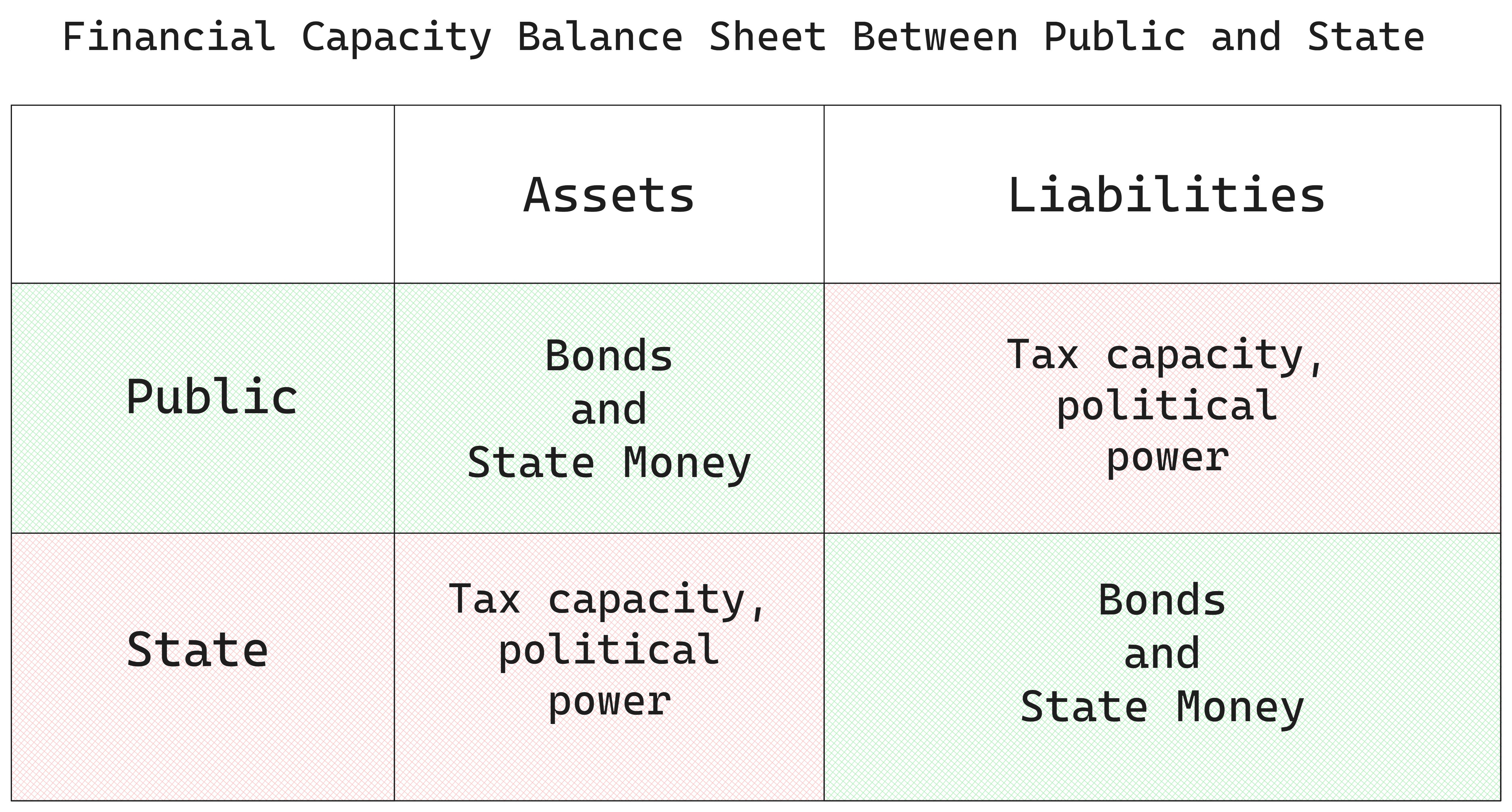
What helps to explain this is when we connect this to taxation. The state agrees to accept this money as payment for taxes. This means that any form in which the recognized nominal unit of value takes, (coins, paper, bank-deposits) because something that the state is required to accept as payment for fines and taxes (Davis 2010, p. 414)
Now we can return to the question of revenue. In technical terms, there is no limit to the amount of money the state can create for itself. There are real practical and political limitations, but since the state issues its own money it can simply issue more money and thus cannot default on debt in its own money. This does not mean it should spend whatever it wants, but the idea that it functional can is important, because we can later investigate why it does or does not use its full monetary power to backstop the economy.
While taxation is critical, the fiscal powers of the capitalist state would be incomplete without understanding the role of state debt. Governments can issue debt in the form of bonds (a liability) backed by its taxation capacity, and political hegemony (an asset) (Davis 2013, 48) (see table above). In general, government bonds are thus considered a highly secure asset, providing a center of gravity for the entire financial system. The confidence of market-actors in the currency itself also follows to government debt, as states can run massive deficits if borrowers believe they will ultimately pay it off (Davis 2013, 54). This gives some states the option to attract funds through the issuance of debt without necessarily increasing the tax burden.
In general bonds can function as a financialized form of surplus redistribution in which the state can help actors by choosing to who they are issued, effectively redirecting surplus to them. Since debt management and payment is a priority for capitalist states, debt holders are effectively the recipients of state tax resources. The words of this illustration titled The Janus Faces of the Modern State capture exactly how the fiscal powers of the state are used as a weapon of class power:
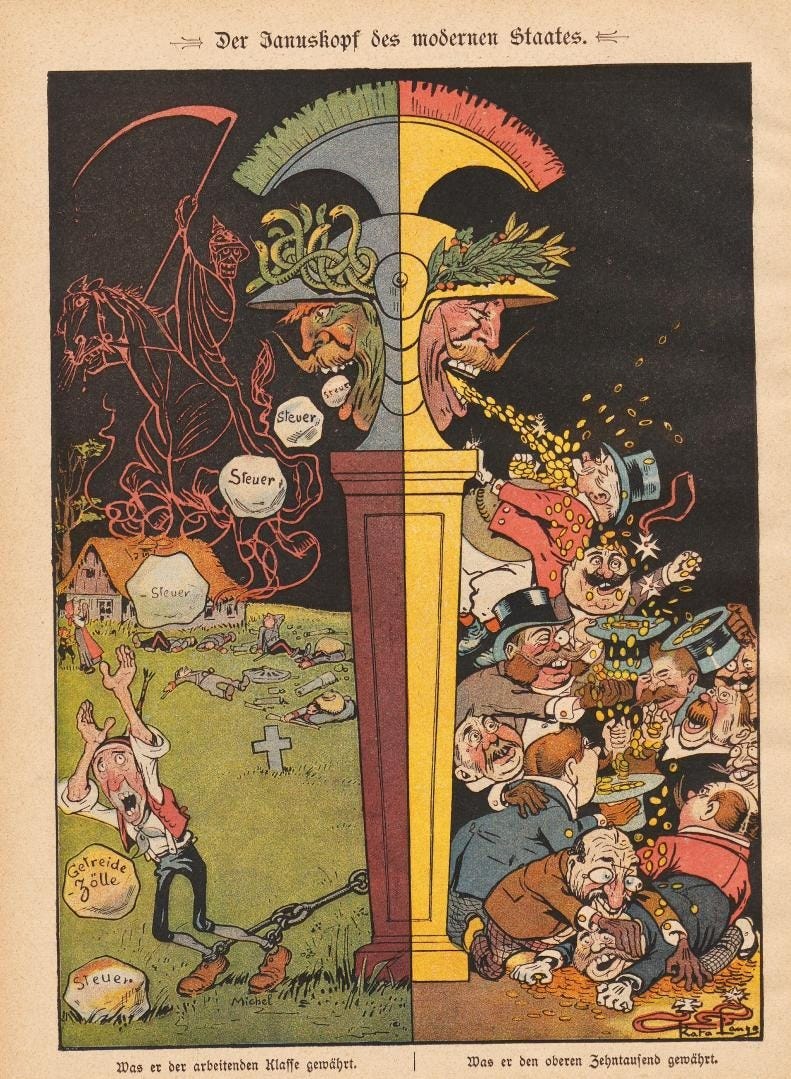
What it grants the working class (taxes) | What it grants the upper ten thousand
Taxes are much less about ‘funding’ the government than a tool of class management. It’s clear it allows for the upper redistribution of wealth, but it’s also a direct means of class compulsion. The use of taxation to establish colonial systems by Western states is a well documented example of its use as a tool of class power (Forstater 2005).
Capitalist states are constantly evolving
As we delve more concretely into the history, it will be clear why understanding state fiscal powers will be relevant for the politics of infrastructure finance. However, it's important to note that these capacities developed over time. These functions and the policies are products of the dialectical interaction between capitalist social forms and their historical development over time (Maher 2022, 3). The subsumption of our social relations to capitalism, a process fundamentally realized and mediated by state policies, always takes on changing historical forms.
As new contradictions and needs grow out of ever-changing relations of accumulation, so too do the roles of the state as a result. The articulation of new modalities through which the social relations of capital are realized materially is the process through which states develop new institutions, policies, and capacities to deal with ever present contradictions of capital.
This means precisely that periods of accumulation evolve not simply because of changing dynamics within the private sector but state actions as well. Rather than being a passive actor the capitalist state is “an active force with its own internal dynamism” (Maher 2022, 13). Marxian analyses have referred to this as the ‘relative autonomy’ (Poulantzas 1978, 161) of the state, the fact that it maintains “autonomous capacities to act on behalf of the system as a whole” (Panitch and Gindin 2012, 4). State actors both deal with the fallout of social crises and are pro-active, meaning they are forward-looking in their support for capitalist social relations. Historical change and the co-dependent evolution of the political and economic will be a central theme going forward in my analysis of infrastructure provision.
Before delving into the real substance of this series, there's one central question that needs to be addressed. That is, how do states know what policies are required for a given period of accumulation? What is the relationship between the political class and ruling class? How do state actors know what needs to be done? This will be the subject of the next piece in the series.
References
Burnham, Peter. 1991. “Neo-Gramscian Hegemony and the International Order.” Capital & Class 15 (3): 73–92. https://doi.org/10.1177/030981689104500105.
Clarke, Simon. 1992. The State Debate. 3rd ed. London: Palgrave Macmillan Limited.
Davis, Ann. 2010. “Marx and the Mixed Economy: Money, Accumulation, and the Role of the State.” Science and Society 74 (3): 409-428. 10.1521/siso.2010.74.3.409
Davis, Ann E. 2013. “The New ‘Voodoo Economics’: Fetishism and the Public/Private Divide.” Review of Radical Political Economics 45 (1): 47–65. https://doi.org/10.1177/0486613412447057.
Gabor, Daniela. 2021. “Revolution Without Revolutionaries: Interrogating the Return of Monetary Financing.” SocArXiv. https://ideas.repec.org//p/osf/socarx/ja9bk.html.
Gabor, Daniela, and Cornel Ban. 2016. “Banking on Bonds: The New Links Between States and Markets.” JCMS: Journal of Common Market Studies 54 (3): 617–35. https://doi.org/10.1111/jcms.12309.
Forstater, Mathew. 2005. “Taxation and Primitive Accumulation: The Case of Colonial Africa.” In The Capitalist State and Its Economy: Democracy in Socialism, edited by Paul Zarembka, vol. 22. Research in Political Economy. Emerald Group Publishing Limited. https://doi.org/10.1016/S0161-7230(04)22002-8.
Matthews, Peter Hans. 1996. “The Modern Foundations of Marx’s Monetary Economics.” The European Journal of the History of Economic Thought 3 (1): 61–83. https://doi.org/10.1080/10427719600000004.
Maher, Stephen. 2022. The Making of the Integral State. Marx, Engels, and Marxisms. Cham: Springer International Publishing. https://doi.org/10.1007/978-3-030-83772-3_1.
Panitch, Leo. 1977. “The Role and Nature of the Canadian State.” In The Canadian State, edited by Leo Panitch, 3–27. Toronto: University of Toronto Press. http://www.jstor.org/stable/10.3138/j.ctvcb5d84.4.
Panitch, Leo, and Sam Gindin. 2012. The Making of Global Capitalism: The Political Economy of American Empire. Brooklyn, NY: Verso.
Payments Canada. 2022. The Role of the Canadian Payments System. Ottawa: Payments Canada.
Poulantzas, Nicos A. 1978. Classes in Contemporary Capitalism. London: Verso.
Reuten, Geert. 1988. “The Money Expression of Value and the Credit System: A Value-Form Theoretic Outline.” Capital & Class 12 (2): 121–41. https://doi.org/10.1177/030981688803500108.
Williams, Michael. 2000. “Why Marx Neither Has Nor Needs a Commodity Theory of Money.” Review of Political Economy 12 (4): 435–51. https://doi.org/10.1080/09538250050175127.
Wray, L. Randall. 1999. “Theories of Value and the Monetary Theory of Production.” SSRN Electronic Journal, ahead of print. https://doi.org/10.2139/ssrn.150497.
I did write a separate piece using some of my original research paper to discuss the state. There will be overlap with this series, but it is more focused on the issues of class and state politics in general.
Burnham and Clarke of the Open Marxist tradition see the state as “essentially a regulative agency”. Despite the correct claim that politics are predicated on the well-functioning of accumulation, the reduction of the state to a mere regulative body negates the indeterminate role of history, politics, and class struggle in the determination of policy. This leads to an ahistorical understanding of how states actually act as an active force in their own right.
Much of my understanding of money has been influenced by Chartalism and Marxism. Although I have some disagreements with particular points regarding the limits of state monetary power, the general insights on the nature of money, state finances, and state liabilities are important.
Nice article, but you really need a copy editor.
I’ve really appreciated your infrastructure financing series, especially the way it exposes the integral role the state plays in organizing and enabling capital accumulation through public-private partnerships. Your breakdown of P3s and asset management captures a dynamic I’ve also been working to name.
In my own work, I frame the modern capitalist order as a two-headed monster: one head is capital, the other is the state, but both operate together through the fraud of legitimacy. Capital doesn’t exploit through pure force; it needs the state's stamp of consent, legality and narrative to make it all seem neutral, even natural. Your work on “enabling fields” and institutionalization of infrastructure deals fits directly into this pattern.
I think there’s real synergy in our approaches and would love to stay in touch or explore some kind of cross-commentary. Happy to share more about my current writing if it’s of interest.
In solidarity,
Ben Eicher
If you are interested and have time, this short essay frames my thesis for both state and capital in a way that may help you and your project or allow you to help me and mine. Very much open to it. https://beneicher.substack.com/p/interlude-explanatory-essay-on-the?r=5j9uex