


social reproduction
The process of continually renewing a set of social relations of production. All forms of production in general require continually reproducing the conditions for the physical reproduction of human actors through their appropriation of the natural world. In other words, there are specific relationships of social metabolism. This process is further mediated by social relations. , i.e., specific forms of relationships between human subjects.
Understanding social reproduction can be achieved at varying levels of abstraction. First, the most abstract form of a given society constitutes a mode of production. Second, adding more concrete determinations (e.g., historically specific forms of relations) shows us the reproduction of a given social formation. Finally, when looking not only at a specific social formation but precise historical moment, we’re looking at a given conjuncture of social reproduction.
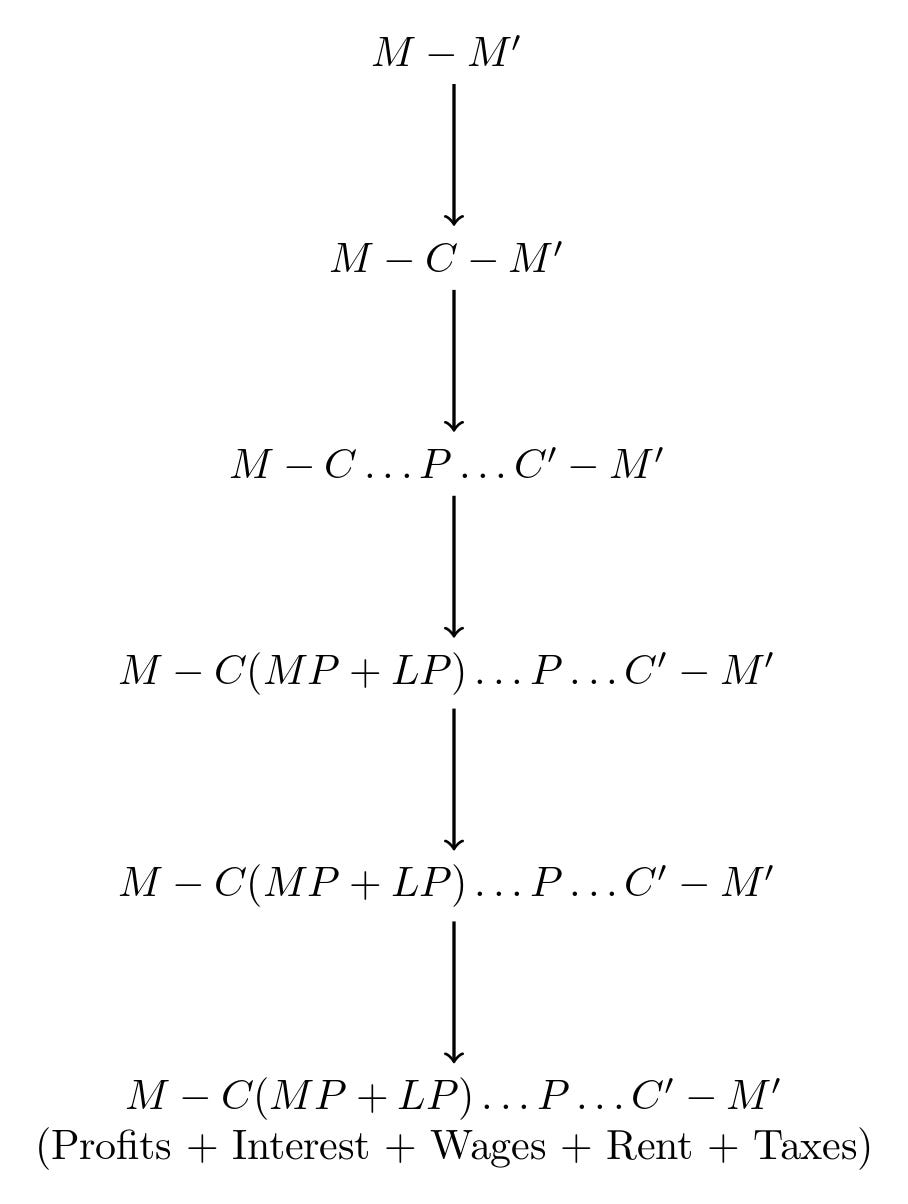
As a method, attempting to outline a given societies social reproduction requires asking the specific question how does this society (re)produce its social relations? For example, when looking at the expanded circuit of capital we can immediately see some interconnections between the various classes.
Here we have social actors represented as bearers of their forms of revenue. These are:
Labor as Wages
Capital as Profit-Interest
Land as Rent
State as Taxes
However, it is important not to confuse social reproduction with merely referring to ‘physical’ reproduction. The ‘materialism’ in historical materialism is often reduced to this determination, which misses that all material relations of reproduction are also social.
Rather, when thinking about the reproduction process, it requires explaining how social classes (aka social subjects) are reproduced as socio-historic beings politically, economically, ideologically and so on. In other words, how do these concrete subjects exist within a given historical conjuncture.
Finally, it is important to note that this social reproduction is not static but always contains in it the potential for transformation. In fact, it is always transforming. This refers not merely to the relation between simple reproduction vs expanded reproduction but rather the qualitative transformations in relationship. These can either re-articulate capitalism into a new form or they can lead to a completely new mode of production.
Expanded circuit of capital from abstract to concrete
References
Marx, Karl. Capital: A Critique of Political Economy, Volume 1-3. Edited by Ernest Mandel. Translated by David Fernbach. Penguin Classics, 1993.
Hall, Stuart. Gramsci’s Relevance for the Study of Race and Ethnicity (1986) 5–27
Studying the Conjuncture, Stuart Hall
Oxford Reference. “Conjuncture.” Accessed March 25, 2025. https://doi.org/10.1093/oi/authority.20110803095632419.
https://www.marxists.org/glossary/terms/althusser/index.htm
Jäger, Johannes, Laura Horn, and Joachim Becker. “Critical International Political Economy and Method.” In The Palgrave Handbook of Critical International Political Economy, edited by Alan Cafruny, Leila Simona Talani, and Gonzalo Pozo Martin. Palgrave Handbooks in IPE. Palgrave Macmillan, 2016. https://doi.org/10.1057/978-1-137-50018-2_7.
If you enjoy my work and want to support it, the best thing you can do is like, repost and share it on other platforms. The most important thing is that people learn something from my work!.
You can also become a paid subscriber on Substack or make a one time donation of a ★🚩revolution🚩★ here . If you’re Canadian, I accept e-transfers by email instead of going through Stripe, this avoids fees and taxes for me and the exchange rate for you.