


The Wall Street Consensus, coined by Daniela Gabor, is a set of policy practices that pushes developing nations to create ‘investible’ development projects to attract the trillions of idle dollars of private capital from global (mainly Western) investors (Gabor 2021, p.2). The model promotes the use of public-private partnerships (P3s) to make projects investable.
This model is seen as the solution to achieving the Sustainable Development Goals. It seeks to deal with the age of the portfolio glut and ‘escort’ global north institutions investors and managers trillions into development asset classes (Gabor 2021, 3). To support the use of P3s, it encourages the creation of user fees for infrastructure. However, it can potentially support this through cash transfers and universal basic income made to the poor (Gabor 2021, p. 8)
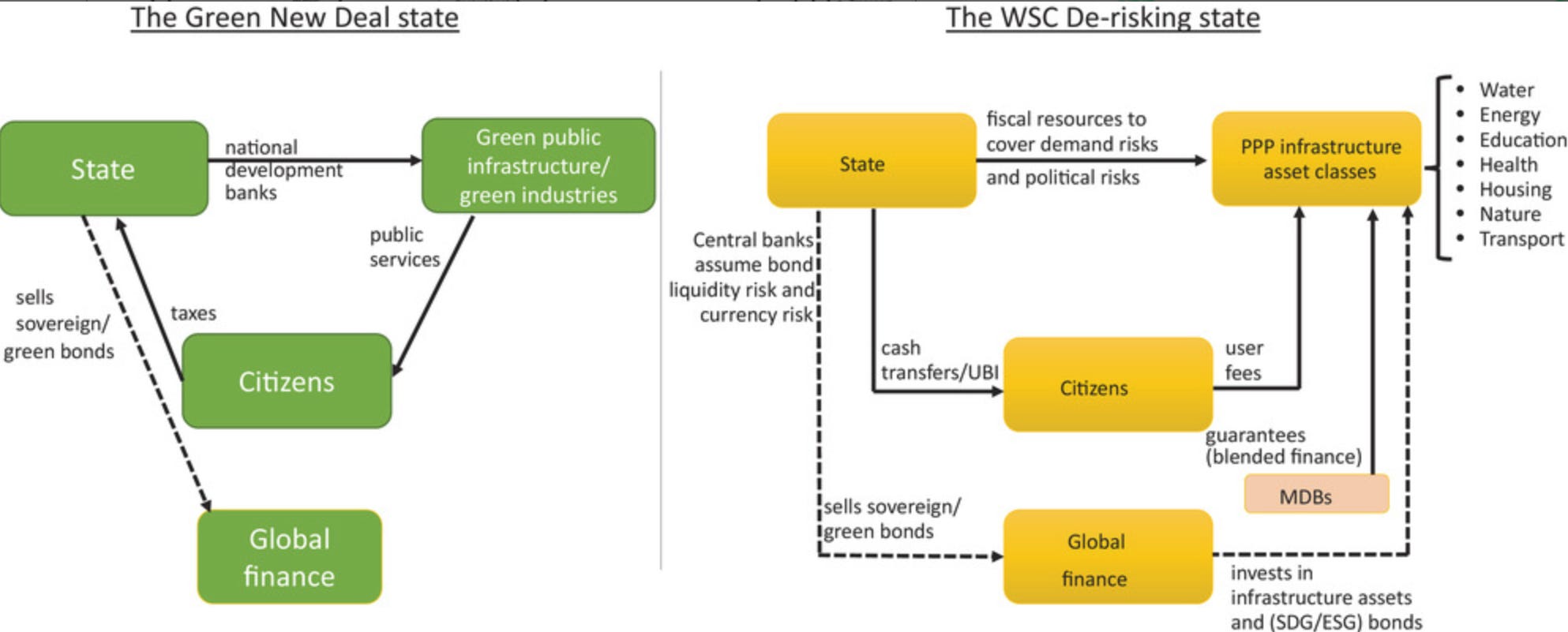
This model differs from simple privatization, precisely because it’s explicit that the state must support the projects to make them investable. There are two requirements for developing states to make their projects ‘investable’‘ (Gabor 2021, 3):
have the state de-risk development assets
structurally transform local financial systems towards market-based finance It employs the use of a de-risking state, which seeks to extend the structural dependency of the state on private finance above the traditional spaces of monetary policy and fiscal policy. The list of potential resources to be transformed into assets classes include water, housing, energy, health, education, transport, and even nature can be transformed in asset classes (Gabor, 2021, p. 8)
Politically it’s a project of class power which seeks to reorient state resources and institutions toward protecting the power of modern finance capital. It requires power-blocs to consolidate around the de-risking state. The movement from the Washington Consensus to the WSC has represented a rhetorical and ideological shift in capitalist class rule. Rather than relying on the neoclassical myth of the free market, there’s a focus on the need to explicitly fix market failures, including closing funding gaps and de-risking.
Policy Documents
UN Billions to Trillions
G20 Infrastructure as an Asset Class
WB Maximizing Finance for Development
Infrastructure Sector Assessment Programs
Quotes
“We have to start by asking routinely whether private capital, rather than government funding or donor aid, can finance a project. If the conditions are not right for private investment, we need to work with our partners to de-risk projects, sectors, and entire countries.’ - Jim Yong Kim, World Bank Group President” (Gabor, 2021, p. 1)
References
Gabor, Daniela. 2021. “The Wall Street Consensus.” Development and Change 52 (3): 429–59. https://doi.org/10.1111/dech.12645.
If you enjoy my work and want to support it, the best thing you can do is like, repost and share it on other platforms. The most important thing is that people learn something from my work!.
You can also become a paid subscriber on Substack or make a one time donation of a ★🚩revolution🚩★ here . If you’re Canadian, I accept e-transfers by email instead of going through Stripe, this avoids fees and taxes for me and the exchange rate for you.